
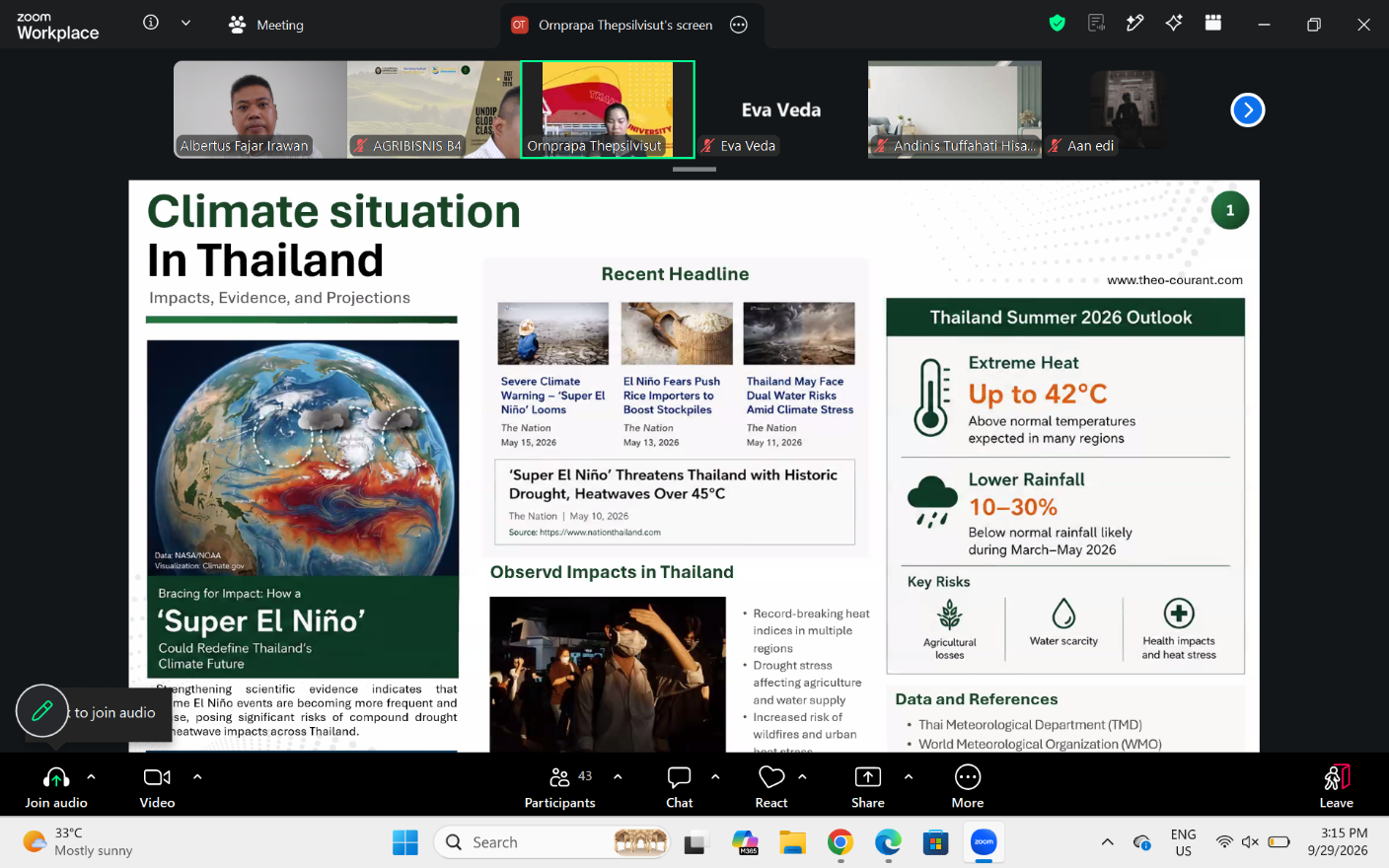
Semarang, Indonesia – Universitas Diponegoro (Undip) continues to strengthen the internationalization of its learning activities through the Undip Global Classroom program, which brings academics from international universities into classroom discussions. In this session, undergraduate students of the Agroecotechnology Study Program, Faculty of Animal and Agricultural Sciences (FPP), Undip, had the opportunity to explore recent developments in agricultural technology in Thailand through a guest lecture entitled “Smart Greenhouse and Zero Waste Nutrient Management for Sustainable Plant Production in Thailand.”
The lecture was delivered by Assoc. Prof. Dr. Ornprapa Thepsilvisut from the Major of Agricultural Technology, Faculty of Science and Technology, Thammasat University, Thailand, on October 1, 2026, from 3:00 to 4:30 p.m. Western Indonesian Time (WIB). The session was attended by third-semester students of Class B as part of the Plantation Crop Cultivation Technology course.
During the lecture, Assoc. Prof. Dr. Ornprapa Thepsilvisut introduced the concept of a smart greenhouse as a modern plant production system that utilizes technology to regulate growing conditions according to crop requirements. Several environmental factors can be controlled, including temperature, humidity, light intensity, water availability, and nutrient supply.
The integration of sensors, monitoring systems, automation, and data management plays an important role in smart greenhouse development. These technologies enable greenhouse managers to monitor environmental conditions more accurately and make cultivation decisions based on real-time data. This approach also reflects the transition from conventional farming systems toward precision and technology-based agriculture.
In addition to greenhouse technology, the lecture highlighted the importance of zero-waste nutrient management. This concept emphasizes the efficient utilization of nutrients by plants, reducing nutrient losses, and minimizing waste that could potentially contribute to environmental pollution. Through more efficient nutrient management, fertilizer use can be optimized while supporting sustainable crop production.
Furthermore, the speaker emphasized that sustainable plant production should not focus solely on increasing crop productivity but also consider the efficient use of water, nutrients, and energy, as well as minimizing adverse environmental impacts. These principles are increasingly important in addressing the challenges of modern agricultural development.
Following the presentation, an interactive discussion session provided students with the opportunity to engage directly with the speaker and deepen their understanding of greenhouse technology, nutrient-use efficiency, and the challenges of implementing sustainable plant production systems. Students also gained insights into agricultural technology developments in Thailand and explored potential applications under Indonesia’s tropical agricultural conditions.
Through this initiative, students gained not only technical knowledge of modern cultivation technologies but also valuable international learning experiences. Direct interaction with an academic from Thammasat University is expected to broaden students’ global perspectives and strengthen their ability to understand emerging developments and challenges in international agriculture.
The Undip Global Classroom program represents one of Universitas Diponegoro’s initiatives to incorporate international learning experiences into its academic curriculum. By involving academics from universities worldwide, the program aims to enrich teaching and learning activities, expand international academic networks, and prepare students to respond to future developments in agricultural science and technology.