
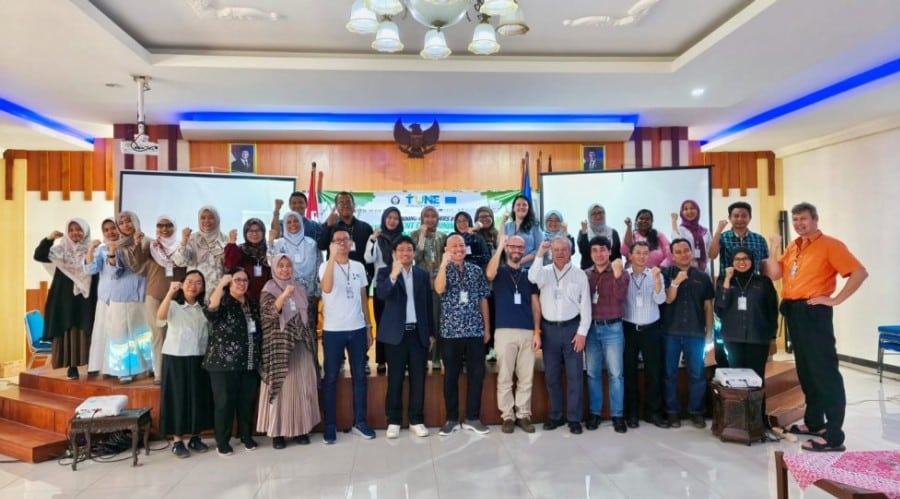
The transnational educational consortium known as the TUNE Project (Nurture Future Green Leaders), co-funded by the Erasmus+ Programme of the European Union, has successfully executed its second Training of Trainers (TOT 2) and fourth Project Management Meeting (PMM4). Convened from January 20 to 23, 2026, at the Faculty of Animal and Agricultural Sciences, Universitas Diponegoro (UNDIP), the four-day assembly represented a pivotal advancement in the institutionalization of sustainability competencies across ASEAN and European higher education frameworks.
The symposium was inaugurated by Prof. Ir. Ts. Dr. Mohd Fadhil Md Din, Project Coordinator from Universiti Teknologi Malaysia (UTM), alongside the leadership of Universitas Diponegoro as the host institution, Prof. Sugiharto, S.Pt., M.Sc., Ph.D. Dean Faculty of Animal and Agricultural Sciences and Prof. Dr. Ir. Florentina Kusmiyati, M.Sc. as the TUNE Project Coordinator on UNDIP.
The opening sessions were dedicated to a rigorous evaluation of the inaugural Replication Seminars. Utilizing the “Cascade Model of Capacity Building,” the consortium analyzed the efficacy of knowledge transfer mechanisms employed by partners including Universiti Teknologi Malaysia (UTM), Universiti Sains Malaysia (USM), Universiti Teknologi MARA (UiTM), Universitas Hasanuddin (UNHAS), Universitas Diponegoro (UNDIP), Hanoi University of Science and Technology (HUST), and the National Institute of Agricultural Planning and Projection (NIAP). These strategic reports underscored the successful dissemination of green expertise from core trainers to broader institutional stakeholders, validating the project’s initial pedagogical approach.
A central component of the TOT 2 agenda was the advancement of pedagogical innovation focused on “Sustainability Leadership.” Facilitated by Assoc. Prof. Dr. Harald Armin Friedl of FH JOANNEUM (Austria), this module interrogated the theoretical and practical applications of “Systemic Consensus Building.” The curriculum redefined sustainability leadership as a participative process designed to align organizational culture with long-term ecological resilience and ethical governance.
In parallel, the consortium addressed the critical intersection of digital transformation and sustainability education. Sessions on “Upskilling: Instruments and Applications,” led by Dr. João Poças Martins (University of Porto) and Dr. Dianah Mazlan (USM), introduced advanced pedagogical tools. Participants engaged with the responsible integration of Generative AI and the RISEN framework for prompt engineering, acquiring the competencies necessary to develop interactive, AI-enhanced learning content via platforms such as Moodle, H5P, and Lumi.
The event concluded with a focus on strategic governance during the Project Management Meeting (PMM4). The consortium reviewed the “TUNE Trilogy” roadmap, a structural framework guiding the project through three distinct phases: Operational Reflection, Strategic Governance, and Network Integration. To ensure the project’s sustainability beyond the grant period, seven ASEAN working groups developed comprehensive action plans for the upcoming Replication Seminar 2. These plans were aligned with the “Quadruple Helix Model,” fostering robust collaboration between academia, industry, government, and civil society.
Looking forward, the consortium formalized preliminary planning for the 1st TUNE International Conference and Exhibition, scheduled to take place in late 2026 in Hanoi, Vietnam. Co-hosted by HUST and UNDIP, this forthcoming summit aims to convene over 300 delegates and specialized exhibitors to facilitate formal ASEAN-EU collaborations in green skills and innovation.
About the TUNE Project The TUNE Project is a global partnership led by Universiti Teknologi Malaysia (UTM), incorporating European partners Vilnius Tech, FH JOANNEUM, and the University of Porto, alongside six major ASEAN institutions. The project is dedicated to bridging the ASEAN-EU green skills gap through curriculum development, multi-stakeholder networking, and the fostering of future green leaders.